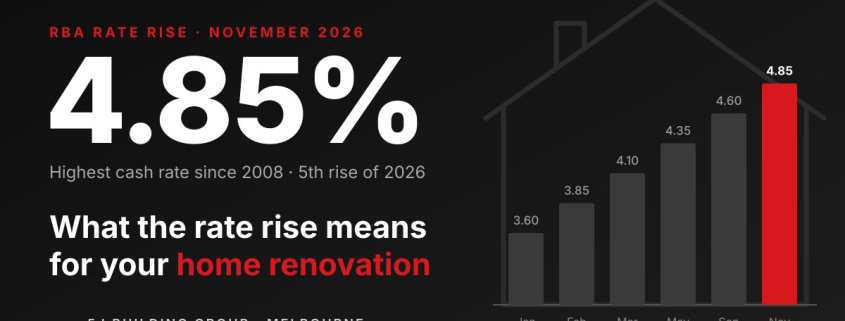
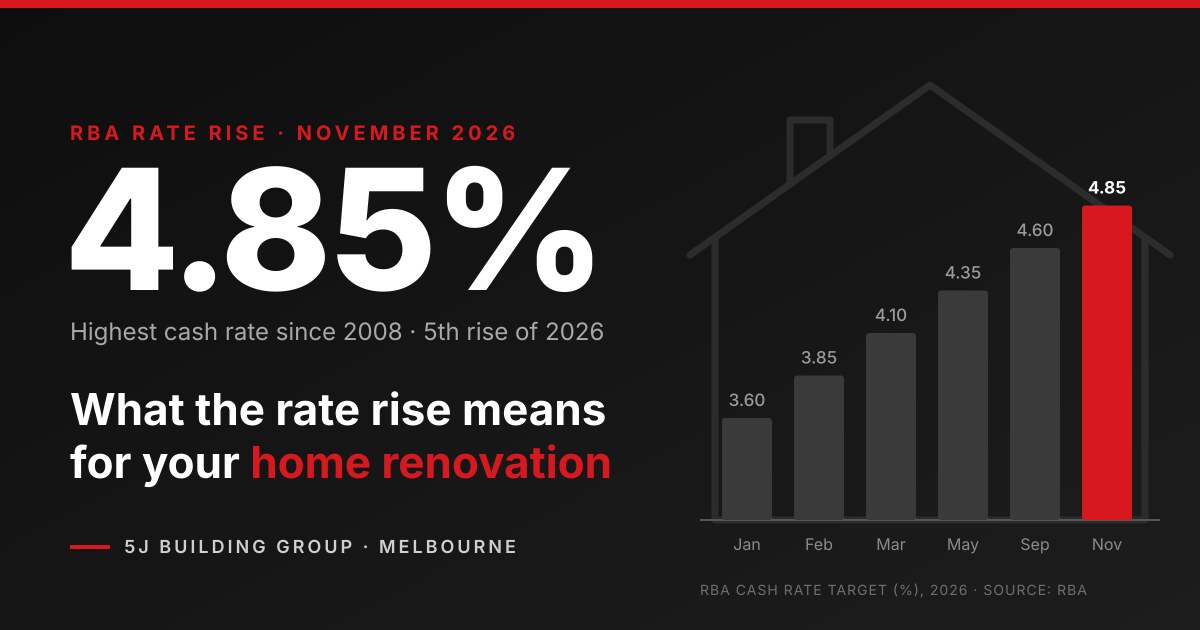
On Melbourne Cup Day, while most of the city was watching the race, the Reserve Bank of Australia made a call that will matter far longer than any trifecta. On 3 November 2026, the RBA’s Monetary Policy Board lifted the official cash rate by 25 basis points to 4.85%, its highest level since November 2008.
For homeowners weighing up a renovation, it’s a fair moment to pause and ask: should we still go ahead? What will it cost? And is renovating still smarter than selling up and moving?
This article looks at what the official numbers are actually saying, what they mean for Melbourne’s renovation market, and what 5J Building Group is doing to help clients plan with certainty in a higher-rate environment.
The numbers behind the decision
The November increase was the fifth rate rise of 2026, following hikes in February, March, May and September. All up, the cash rate is now 1.25 percentage points higher than it was at the start of the year. The decision wasn’t unanimous: six Board members voted to raise rates, while three preferred to hold at 4.60%.
The driver is inflation. According to the Australian Bureau of Statistics (ABS), the Consumer Price Index rose 4.3% in the 12 months to September 2026, up from 4.0% in August. Well above the RBA’s 2–3% target band.
What’s especially relevant for anyone planning building work is where that inflation is coming from. The ABS identified housing as the largest contributor to annual inflation, up 5.2%, with new dwelling prices rising 4.7% over the year as builders passed on higher material and labour costs.
In plain terms: borrowing has become more expensive, and so has building.
What the rate rise means for homeowners
Higher repayments, less borrowing headroom
For an average household with a mortgage, every rate rise squeezes the monthly budget a little further. Industry estimates suggest a $500,000 loan could see repayments rise by around $80 a month from this increase alone, and Domain’s research team estimates each 25-basis-point rise trims borrowing capacity by roughly 2.5%.
That matters for renovation finance. Whether you’re drawing on equity, using a redraw facility or applying for a construction loan, lenders will be assessing your application against higher rates and tighter serviceability buffers.
Moving has become even more expensive
Here’s the flip side. If borrowing is dearer, so is buying a new home, and in Victoria, the upfront costs of moving (stamp duty, agent fees, legal costs and removalists) can easily run into tens of thousands of dollars before you’ve spent a cent improving the new place.
For many Melbourne families, that maths points strongly towards improving the home they already own rather than trading up. You keep your location, your schools and your community, and every dollar goes into the house rather than into transaction costs.
What the ABS data says about the renovation market
The latest ABS Building Approvals release (September 2026, published 2 November) tells an interesting story.
- The value of new residential building approvals fell 3.3% to $9.74 billion.
- Over the same month, the value of residential alterations and additions rose 0.8% to $1.32 billion.
- Private sector house approvals fell 5.3% nationally.
In other words, while new home building is softening, renovation activity is holding its ground. The ABS trend series shows alterations and additions easing slightly (down 0.7% to $1.31 billion), so it isn’t booming, but it’s proving more resilient than new construction as rates climb.
That pattern is consistent with past rate cycles. When moving gets harder, homeowners don’t stop wanting more space, a better kitchen or a second bathroom. They simply look to deliver it within their existing four walls.
The real risk: cost blowouts, not the rate itself
For most renovators, a 0.25% rate rise on its own isn’t what derails a project. What causes real financial stress is uncertainty: a quote that grows mid-build, variations that weren’t anticipated, or a timeline that drags on while you’re paying rent elsewhere or carrying a construction loan.
With new dwelling costs rising 4.7% year on year, a vague or “estimate only” quote is a genuine risk to your budget. In a higher-rate environment, every unplanned dollar costs more, because it’s often borrowed.
That’s why how you plan and contract a renovation matters more now than it did two years ago.
How 5J Building Group is responding: our proactive initiatives
At 5J Building Group, we’ve been building and renovating Melbourne homes through all kinds of market conditions. Here’s how we’re helping clients renovate with confidence while rates are high.
1. Detailed, transparent quoting up front
We do the work before you sign: a thorough site assessment, clear specifications and itemised pricing. You’ll know what’s included, what isn’t, and where the potential cost risks sit, so there are no surprises halfway through the build. When every dollar is borrowed at 4.85%, certainty is worth a lot.
2. Staged and prioritised renovation plans
Not every renovation needs to happen at once. We help clients break a larger vision into logical stages, for example starting with a kitchen renovation or a bathroom renovation, then tackling an extension or second storey when finances allow. Each stage is designed so the next one fits seamlessly, avoiding costly rework later.
3. Smart material selection and early procurement
Material costs are a major driver of building inflation. Our team works with clients to select materials that deliver quality and durability without unnecessary premiums, and we lock in key materials early where possible to protect your project from further price movements.
4. Tight programming to reduce holding costs
Every extra week on site can mean extra interest, rent or disruption. We plan our builds carefully, coordinate trades efficiently and keep clients informed at every milestone, so your project finishes on time and your holding costs stay under control.
5. Renovations that add long-term value
In a higher-rate market, a renovation needs to work hard. We focus on improvements that genuinely lift liveability and resale value: better layouts, extra bedrooms or bathrooms, improved natural light and energy-efficient upgrades that reduce running costs for years to come.
6. Honest advice, even when it means “not yet”
Sometimes the right advice is to scale back, rephase or wait. We’d rather give you an honest assessment of what makes sense for your budget than oversell a project that puts pressure on your household finances.
Should you renovate now or wait?
There’s no one-size-fits-all answer, but here are a few questions worth asking:
- Is your current home working for your family? If you’re out of space or the layout no longer suits, waiting for rates to fall could mean years of compromise.
- Can you service the loan with a buffer? Talk to your lender or broker about how your repayments would look if rates rise further. The RBA meets again on 7–8 December.
- Is your quote fixed and detailed? A clear, comprehensive quote protects you far more than a rate cut ever could.
- Does the project add lasting value? Prioritise works that improve how you live and what your home is worth.
Building costs have historically trended upward over time, so delaying a well-planned project doesn’t always save money. Often it just shifts the expense to a later, potentially more costly date.
The bottom line
The RBA’s move to 4.85% is a clear signal that the cost of money will stay elevated for a while. But the official data shows Melbourne homeowners aren’t abandoning their renovation plans. They’re getting smarter about them. With moving costs high and new building slowing, improving the home you already love remains one of the most sensible investments you can make.
The key is to renovate with a clear budget, a detailed plan and a builder who prioritises certainty.
If you’re thinking about a home renovation in Melbourne and want to understand what’s achievable within your budget, get in touch with the 5J Building Group team for an honest, no-obligation conversation.
Sources
- Reserve Bank of Australia, Monetary Policy Decision, 3 November 2026: https://www.rba.gov.au/media-releases/
- Australian Bureau of Statistics, CPI rose 4.3% in the year to September 2026: https://www.abs.gov.au/media-centre/media-releases/cpi-rose-43-year-september-2026
- Australian Bureau of Statistics, Building Approvals, Australia, September 2026: https://www.abs.gov.au/statistics/industry/building-and-construction/building-approvals-australia/latest-release
- Savings.com.au, RBA lifts cash rate to 4.85% (repayment and borrowing-capacity estimates): https://www.savings.com.au/news/rba-lifts-cash-rate-to-4-85